Keras Models
flowchart TD

A[Keras Models]

A --> B[Sequential Model]
A --> C[Functional API]
A --> D[Model Subclassing]

B --> B1[Simple stack of layers]

C --> C1[Multiple Inputs]
C --> C2[Multiple Outputs]
C --> C3[Branching]
C --> C4[Skip Connections]

D --> D1[Custom Forward Pass]
D --> D2[Research Models]
D --> D3[Dynamic Networks]
1. Sequential Model
Every layer has exactly one input and one output. Layers are placed in
linear fashion, to create neural network
Eg: Multi-layer perceptrons (MLPs), Basic Convolutional Neural Networks
(CNNs), Recurrent Neural Networks (RNNs)
flowchart LR

X[Input]

L1[Layer 1]

L2[Layer 2]

L3[Layer 3]

Y[Output]

X --> L1 --> L2 --> L3 --> Y
2. Functional Model
Non-linear data flow, complex layers, shared layers, and multiple
inputs/outputs Supports Multiple Inputs/Outputs
Eg: Multi-input/multi-output models (e.g., a model that takes image and
text inputs to produce a classification and a regression output)
FUNCTIONAL API - GRAPH STRUCTURE
                          ┌─────────┐
                     ┌───▶│ Dense 3 │───┐
┌─────────┐     ┌────┴─┐  └─────────┘   ▼  ┌─────────┐
│ INPUT 1 │────▶│      │             ┌─────▶│ OUTPUT 1│
└─────────┘     │ Dense│             │      └─────────┘
                 │   1  │             │
┌─────────┐     │      │             │      ┌─────────┐
│ INPUT 2 │────▶│      │───┐         └─────▶│ OUTPUT 2│
└─────────┘     └──────┘   │                └─────────┘
                 │         ▼
                 │    ┌─────────┐
                 └───▶│ Dense 2 │
                      └─────────┘
3. Model Subclassing (Research, highly custom architectures)
Provides highest level of flexibility, allowing to implement everything
from scratch by subclassing the tf.keras.Model For dynamic
architectures, such as models that require custom loops or conditional
logic in the forward pass Supports Multiple Inputs/Outputs
Eg: Out-of-the-box research models or custom architectures like a
Tree-RNN
Layers in Keras?
Layer is combination of
Neurons. 1 layer will have
multiple neurons
Layer is component used to build a
neural network. Multiple
layers are stacked together to create a neural network. Output from 1
layer is fed to other.
Types of Layers
Common Keras layer types include:
1. Dense — fully connected layers for general-purpose
modeling.
2. Conv2D / Conv1D — convolutional layers for images, time
series, and spatial data.
3. Pooling — downsampling layers such as
MaxPool2D and AveragePool2D.
4. Dropout — regularization layers that randomly drop
units during training.
5. Normalization — layers such as
BatchNormalization and LayerNormalization.
1. Dense Layer
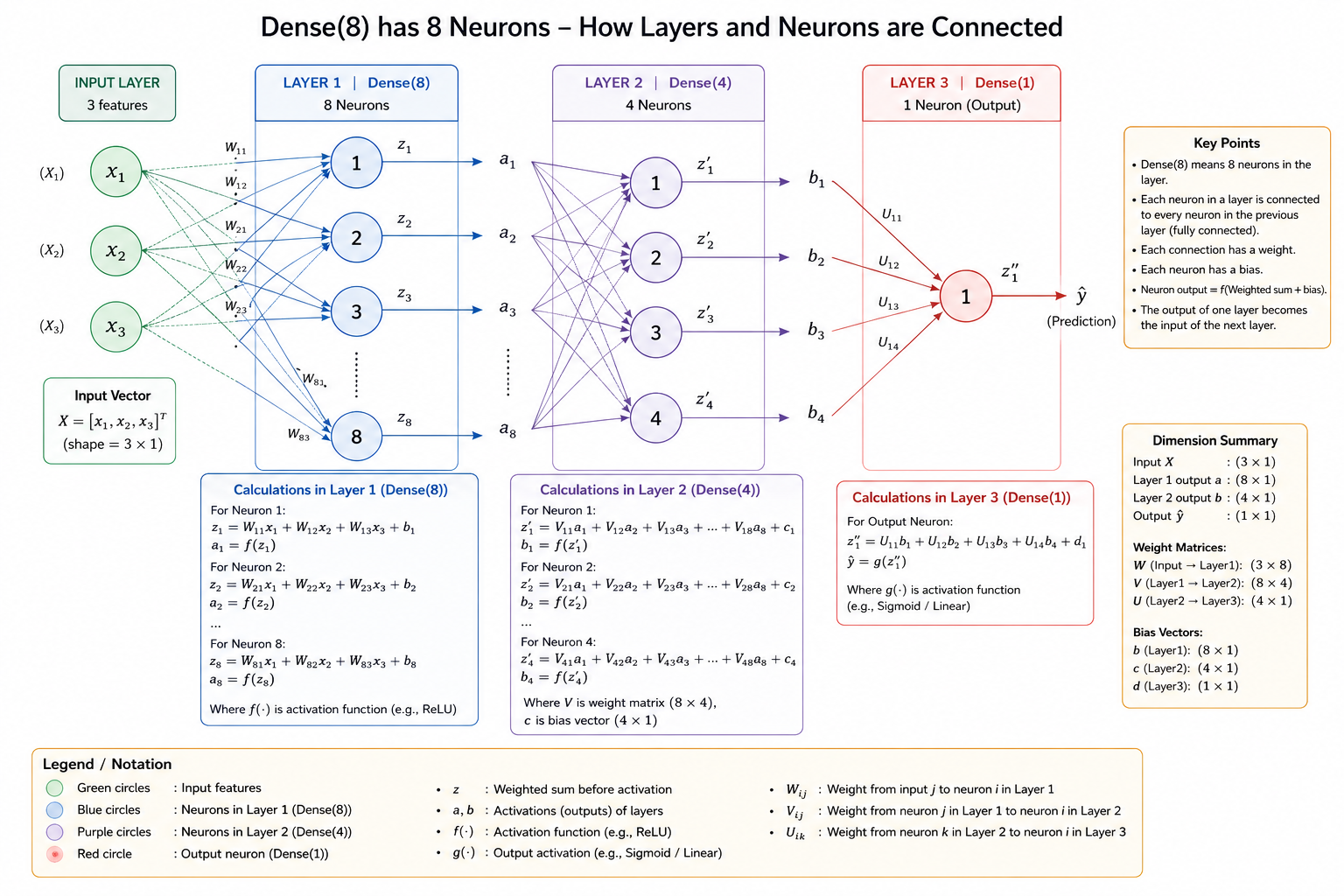
Dense(8) = Layer with 8 neurons. 8 labels
Dense(4) = Layer with 4 neurons. 4 labels
Dense(1) = Layer with 1 neuron. 1 label
Neural Network = {Dense(8)
-> Dense(4) -> Dense(1)}
How Neurons Per layer and number of layers is decided
Number of input features → Determined by your dataset.
Example: Age, Salary, Experience = 3 features.
Number of neurons per layer → Chosen by the model designer (a
hyperparameter).
Number of hidden layers → Also chosen by the model designer.
Create Neural Network
In Keras you mostly call functions (or constructors that look like
functions). Each call creates an object — a layer, a model, or a
training setting — and you chain them together.
Think of it like building with LEGO: layers.Dense(...) is one brick,
keras.Sequential([...]) is the base plate that holds the stack,
model.compile(...) tells Keras how to train, and model.fit(...) actually
runs training.
flowchart LR
  A["1. Define model
Sequential / Functional"] --> B["2. compile()
optimizer, loss, metrics"]
  B --> C["3. fit()
x, y, epochs, batch_size"]
Functions
Containers
Sequential([...]), Model
Hold layers together — the neural network object
Layers
Layers.Input(shape=(...))
How much data the model expects. The shape of the input data
(features).
keras.Layer.Dense(n)
Linear Regression: y = mx + b (1 feature, 1 output) |
MLP — binary classification: y = m1x1 + m2x2 + ... + b (n
features, 1 output) |
Layer.Dropout(rate)
# MLP — multi-class classification: y = m1x1 + m2x2 + ... + b  (n features, K outputs)
model = keras.Sequential([
    layers.Input(shape=(784,)),                     # 784 input features (x1, x2, ... x784)
    layers.Dense(128, activation="relu"),           # Layer with 128 Neurons. 128 labels(y1, y2, ... y128)
    layers.Dropout(0.2),                            # Drop out 20% of the neurons
    layers.Dense(10, activation="softmax"),         # Layer with 10 Neurons. 10 labels(y1, y2, ... y10)
])
Train, Predict
compile(optimizer, loss, accuracy)
Configure the model for training. optimizer(adam), Loss(binary_crossentropy)
model.compile(
  optimizer="adam",
  loss="binary_crossentropy",
  metrics=["accuracy"],
)
fit(x, y, epochs, batch_size)
Train the model
predict(x)
Make predictions with the model
predictions = model.predict(X_validation, verbose=0)evaluate()
computes the performance metrics (like loss and accuracy) of a trained model
loss, accuracy = model.evaluate(X, y, verbose=0)Optimizer / loss
SGD, Adam, RMSprop, "mse"
Passed into compile() — not layers
What Sequential cannot do easily
Use the Functional API (above) when you need multiple inputs, multiple outputs, shared layers, or skip connections (ResNet, U-Net, two-tower models). Use Model subclassing for fully custom forward passes (GANs, neural ODEs, dynamic graphs).